
This is an old revision of the document!
Table of Contents
Paid Analysis
Home
Paid users can select up to 4 years of data for analysis, and, if you have paid for more than one business to analyse, you can click the + button to create a new business.
 If you have already entered data for the business, you can click on the View Analysis button to go straight to the output screen, otherwise press the Next or Edit input data button to progress to the Profile screens to enter your data.
Data Input
Business Profile
At the top of this section you define the currency and scale to use when entering financial data. The rest of the screen is split into 2 sections:
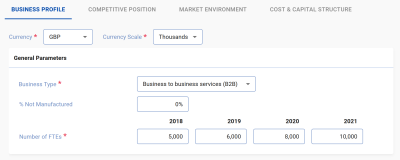
The first section defines key structural factors for your business:
- The currency used entering financial
 data
data - Business Type: an overall business classification into 1 of 6 categories.
- The % of products not manufactured: What percentage of your sales involve no manufacturing process at all (e.g. services or bought in goods).
- The number of employees in the business unit.
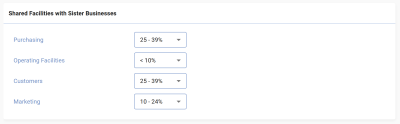 The second section details resources such as plant, marketing and customers which are shared with other
businesses in the company. Like many fields in the softwarethese comprise drop down menus with a range of choices rather than asking for precise numbers.
The second section details resources such as plant, marketing and customers which are shared with other
businesses in the company. Like many fields in the softwarethese comprise drop down menus with a range of choices rather than asking for precise numbers.
Competitive Position
The Competitive position page is divided into 4 sections:
The first section details the Market Shares of your business and its main competitors:
- Your market share in value terms.
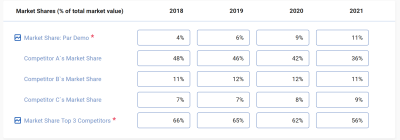
- The market share of each of the 3 largest competitors in the market in descending order of share.
- The combined share of the 3 largest competitors in the market excluding your business.
It is important to correctly define your market, making it too broad means you are not necessarily competing with the largest competitors and understates your share (i.e. if you are competing in a specific region but are considering the worldwide market), or you define it too closely and ignore competing technologies.
The second section looks at Customer Value and Innovation data:
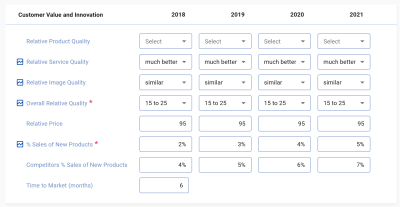
- The relative perceived quality of your business split into product, service and image quality.
- The overall relative perceived quality of your business.
- Your businesses price relative to a market average of 100. A relative price of 105 indicates you are 5% above the average price of competitors, 95 indicates you are 5% below the average.
- Your Business’s % of sales from new products: The definition of new products does not include things like changes in pack sizes or slight modifications to existing products but are step changes, offering a new function to an existing market or an existing product to a new market.
- An approximation of your competitors % sales from new products.
- An approximate time to market for a typical new product launch.
Relative quality is a measure of your business’ performance on non-price attributes relative to your competitors from your customers perspective. A value of less than zero indicates that your customers think you have a worse than average quality relative to competitors, greater than zero that they think you have a better than average quality product compared to your competitors. The range goes from -50 to +50 with the extremes representing very large differences in quality.
Relative service quality is a guide as to whether you offer better or worse associated services (e.g. after sales support, delivery, etc.) than your competitors.
Relative image quality measures how your business / brand is viewed compared to competitors.
The third section details your Relative Cost position 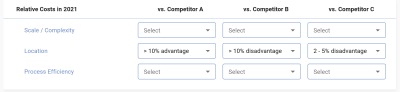 versus each competitor in the latest year, i.e. do you have scale advantages (or disadvantages), location advantages (close to market, cheaper labour cost, cheap energy), or process advantages which together determine the overall relative cost position.
The final section looks at Relative Complexity and has two fields to give an indication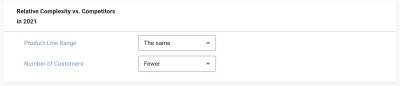 of positioning differences vs competitors In the latest year:
- Do you have a wider or narrower range of products than competitors
- Do you have a wider range of customer types than your competitors.
Press Next to go to the next page, Back to go back to the business profile page.
Market Environment
The Market Environment page is divided into 2 sections.
Growth and Inflation: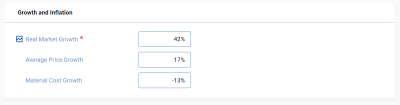
- Real market growth, which is the inflation adjusted average annual market growth rate.
- Average Price Growth, which, as it says is the average annual change in prices.
- Material Cost Growth, which is the annual percent change in the cost of your purchases due to price inflation.
The Customer Characteristics section is split in 2 halves. The first asks for details of customisation and the types of customers you sell to, namely: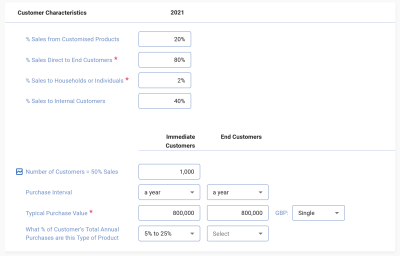
- The % of your sales which are specifically customized for individual customers.
- The % you sell directly to end customers rather than through wholesalers or retailers.
- The % of your end customers who are individuals or householders.
- What percentage, if any, are sold to customers within your organization.
The second details some characteristics of both the immediate and end customers of your business. Immediate customers are those that you directly sell to, and end customers are the final customers who buy your product. So for a confectionary company the immediate customer is the supermarket chain or wholesaler, and the end customer the person who buys it in the shop. However, if you are selling gearwheels to a gearbox manufacturer they are both the immediate and end customer as purchasers further down the supply chain are buying the gearbox (or car) and not your product. We ask for:
- Number of immediate customers = 50% sales. This is the smallest number of customers who you sell to directly who account for half of your sales value and is an indication of how reliant you are on a small number of customers.
- What is the typical purchase interval, i.e., on average approximately how often do you immediate and end customers buy your product.
- What is the typical purchase (contract) amount for both immediate and end customers.
- The % of customers annual purchases do you account for. This gives a measure of your supplier power.
Clicking Next takes you to the Financial Performance page.
Press Next to move to the next section.
Next: The PAR ROS Model