
Table of Contents
The Survey Interview Software
General comments about conducting an interview
- Introduce yourself briefly unless they already know you
- Tell the customer about the benefits to them: “We conduct these interviews with our company’s most important customers to improve constantly our services. Your honest feedback is one of the most valuable sources to adjust them and provide higher customer value.”
- Never speak to an interviewee about other interviews: no results, no places, no names not about your next interviewee. Do not give any feedbacks or personal impressions. Don’t speak about internal problems of your company.
- Make a fluent discussion. Try to avoid the feeling of the interviewee, that he is filling a form.
- If short on time: set priority on CVA form, then open questions.
- Always keep time under control
- Ask for reasons for their scoring and add to the comments.
- Note as many quotes as possible.
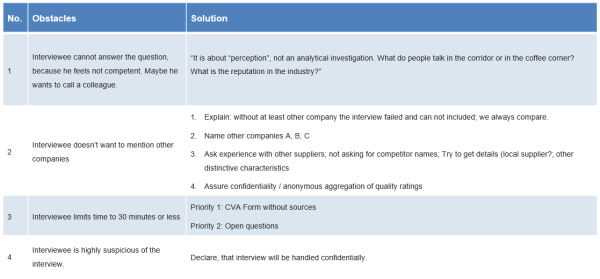
Typical Obstacles
The CVA Input Software
The online CVA input software can be run either by the interviewer or by the respondent using a link to a web-based form. This allows for:
- face-to face interviews.
- On-line teams or zoom interviews.
- Direct web input by the interviewee.
If it is used for the respondent to complete the survey themselves, they are sent a unique link straight to their input form in the language chosen in the interview record.
Interviewers login using https://portal.pims.ai/cvainput/ and select the interview from the list:
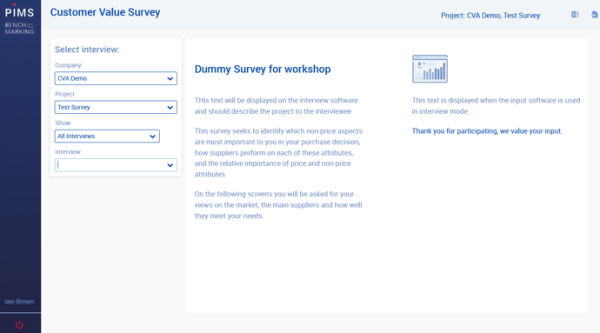
As an interviewer, on selecting the interview you are shown the interview details and offered the choice of wizard or “spreadsheet” type input.
Select wizard to conduct the interview and step through the process.
Step 1: Define the competitors
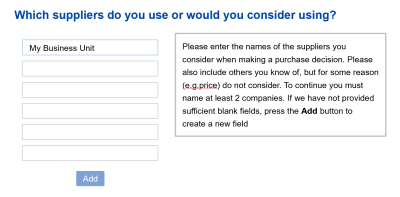
The first step is defining the competitors that the interviewee considers when making their purchase decision:
 Note:
We are entering data from the customers perspective, hence the use of the word “suppliers” in the software.
Note:
We are entering data from the customers perspective, hence the use of the word “suppliers” in the software.
Step 2: Assign them a price relative to "your business"
With the business being analysed as the benchmark, ask the interviewee whether competitors prics are higher or lower, and by how much in percentage terms.
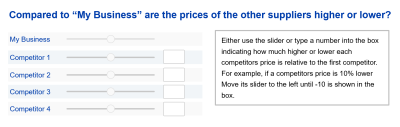 This is one area where interviewees can get worried about giving details for other suppliers, so it is useful to talk about approximations to make them feel more comfortable.
Step 3: Assess the price sensitivity of the market
We want to know the relative importance of price and quality factors in the purchase decision as it has an important factor in detrrmining which offering they purchase. We ask them to weight the relative importance on a sliding scale of 1 - 100, where 50/50 implies equal importance.

Price and quality together determine the relative value of competing offerings. The importance of price vs quality factors in the purchase decision is a measure of price sensitivity. A value > 50 indicates that price is more important in the purchase decision than quality factors and indicates that the products or services are of a similar quality and or fairly standardised.
Step 4: Assign importance weights to each attribute
The next step is to define the reltive importance of each attribute. On loading, the weights are assigned to an average value based on 100 / number of attributes (i.e. if there are 10 attributes they will be initialised at 10).
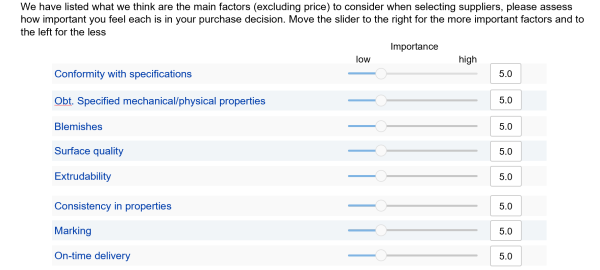
Although weights should sum to 100, the software will rebase weights before calculating quality scores so it is not necessary to be precise. We are looking for relative importance.
Step 5: Score competitors on each attribute
The final step is to score the competitors performance on every attribute (first product, then service, and finally image) on a scale of 1 - 10, where 1 is terrible and 10 indicates that the performance couldn't be bettered.
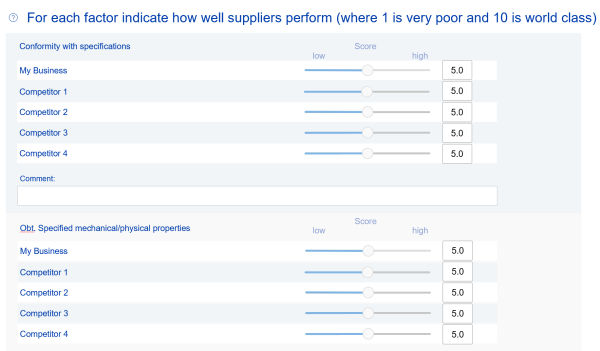 Again, we are looking for relative performance rather than absolute values, it is the distance between competitors tha counts rather than the absolute number. One person's 7 does not indicate the same level of perfromance as someone else's.
This is the last stage of the interview, you can review a summary of the input or submit the interview at this point.