
Table of Contents
Planning the Survey
Overview
There are 4 stages in conducting a Customer Value Survey:
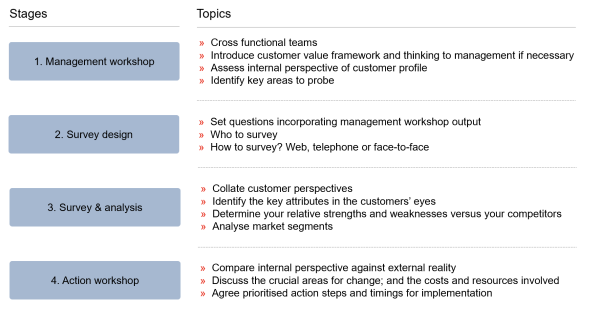
1. Management workshop(s) to define the scope of the project and identify:
- A cross functional team to manage and carry out the project
- Introduces the customer value framework to the team if necessary
- Assesses the internal perspective of customer profile
2. Survey Design:
- Set questions incorporating management workshop output
- Who to survey
- How to survey? Web, telephone or face-to-face
3. Survey and analysis, where you:
- Collate customer perspectives
- Identify the key attributes in the customers’ eyes
- Determine your relative strengths and weaknesses versus your competitors
- Analyse market segments
4. Action Workshop(s), where you:
- Compare internal & external perspectives
- Link the results to company strategy
- Formulatie an action plan for change.
Defining the Analytical Framework
A key element of the management workshop(s) and surrounding discussions is to define the scope of the survey, namely:
 : which markets do we compete in and how are they segmented?
 : who influences the buying decision and who makes the purchase decision?
 : what are the key purchase criteria of customers?
Which market segment(s) are we looking at?
In this context we are looking to determine the scope of the market(s) and also the highest level of aggregation.
- Do we have markedly different products and services?
- Are the customers different?
- Are the competitors different?
- Do customers have different purchase criteria?
- Does the purchase / bid have a different timescale or process?
Generally speaking, if the competitors have little overlap and the purchase criteria are different then there are multiple markets and the market segments cannot easily be combined in an analysis.
Identifying competitors
To ensure that we can aggregate and/or compare worksheets effectively we create an internal list of all the competitors we think respondents will identify.
- Naming competitors ensures we have a consistent market definition.
- For the internal perspective we rate all relevant competitors for that segment.
- When assessing the external CVA perspective, we don’t put them on the sheet for customer interviews – we want to know who they actively consider when buying.
- If the respondent names a competitor that is not on the list it is automatically added when the worksheet is complete
Defining key buying criteria
Buying criteria, (otherwise known as worksheet attributes) are the attributes on which respondents score the competitors performance. Buying criteria should:
- Capture all non-price elements of the purchase decision from the customers perspective.
- Not be too detailed:
- Not be too broad – you need to be able to derive action items.The more attributes there are the lower the average importance of each and therefore its influence. We want participants to think about their answer, too much detail and they will “switch off”.
- Not to be ambiguous – you, customers and interviewers must know what they mean.
- Be able to link back to to internal processes.
When considering the attributes that make up the customers buying criteria we split them into 3 categories:
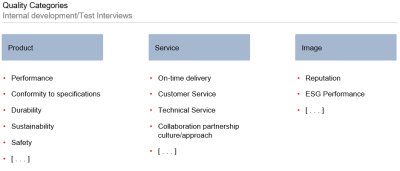
- Product attributes – which is what they buy,
- Service Attributes which are the associated services around that in terms of pre-sales & post sales activities, delivery & support,
- and image attributes which are down to the perception of the company.
The categories can be arbitrary, but we find are a good way of helping focus on what is important and how they might relate back to internal processes. Generally we find that in commodity markets where there is little to differentiate the product, service attributes in particular become more important to the customer. The attributes are defined in workshops such as this, by conducting test interviews, or a mixture.
Within market segmentation
In this context segmentation is looking at types of respondent within a market. It is always better to pre-define Segmentation criteria you don’t use than to try and add them after the survey. You should consider the following possible segmentations:
- Internal view vs External view. It is important that we separate these!
- Region: You should define at a relatively low level (i.e. choose countries or regions rather than Europe), and aggregate up where necessary.
- Respondents function? This can be useful if you are getting more than one interview from a company or if you are conducting several interviews for the Internal view.
- Customer type, size, etc.?
- Existing customer vs prospects.
- Other?
Identify Interviewees
Having determined the segments and regions you are analyzing you can now identify interviewees:
- Which customers are strategically and operationally relevant (existing customers, changing customer) non-customers?
- Which customers are “surveyed to death” or would feel harassed?
- Who is the customer with the most purchasing power (of trade, end customer, …)?
- Which people from which functional areas are involved in the buying decision and what influence do they have on the actual purchase decision?
- Who is it geographically practical to interview?
Review against the segmentation criteria, and revise segmentation and interviewees until you have a reasonable sample size.
Technical Requirements and Important Issues
- Worksheets should have more than two competitors scored to avoid polarised results (minor deviation) in scores can cause big deviations in quality).
- Conversely, having lots of competitors (more than 10) leads to a lower average difference and therefore more similar quality scores.
- Similarly, having just a couple of attributes means that any differences will have a big effect on quality and having lots of attributes leads to a lower average difference and therefore more similar quality scores. Experience has shown that between 8 and 12 attributes should be defined.
- For the above reasons it is preferable to have a predefined list of attributes rather than allowing the participant to have a “free choice”.
- Survey participants will also baulk at being asked to score many competitors on many attributes, and will either stop scoring, or rate everything the same.
- Attributes are only used in calculations where at least 2 competitors are scored and where the weight is greater than zero.
- If the above criterion is not met the attribute weight is not used.
- In a summary, if none of the attributes satisfies these criteria the worksheet is ignored.
- Summaries are calculated using the average of the differences rather than the difference between the averages.
- All attributes/key buying factors (regarding product, service, image) should not be related to price!
Next: Survey Configuration